
Screens, wearables, and “the system flagged something” can feel unsettling. In practice, most clinical technology is built to support your care team—not replace the people who still make the call.
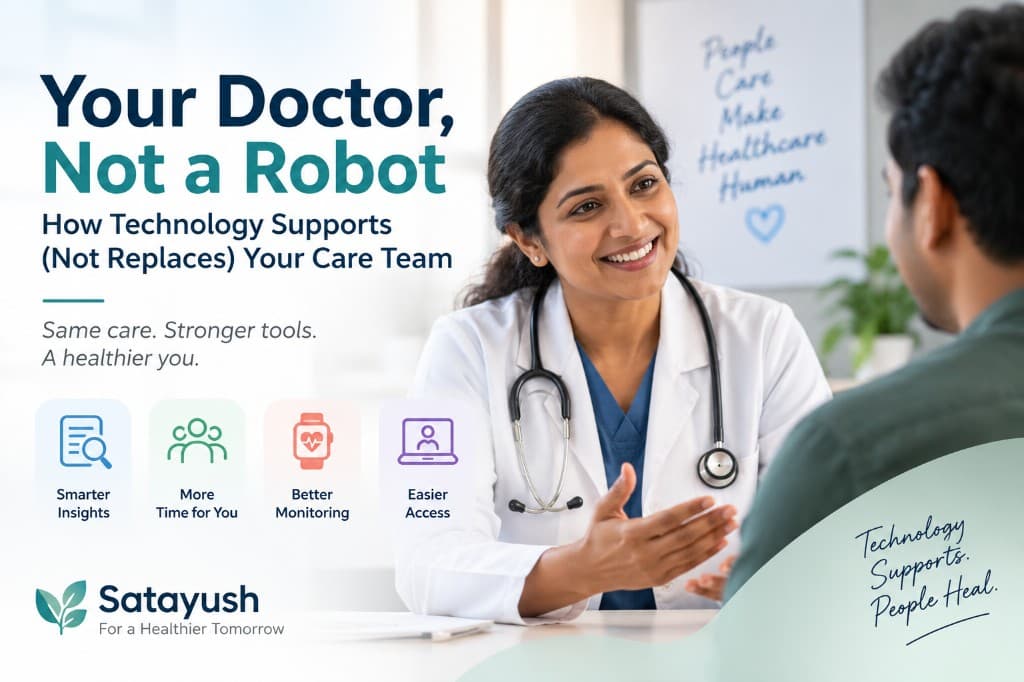
If you have walked into a clinic recently and noticed something new—a screen tracking your visit, a wearable syncing vitals, or your doctor saying the system flagged a result—you may have felt a flicker of unease. Is technology taking over? Is a computer overriding judgment?
Those are fair questions. The honest answer is reassuring: most healthcare technology today is designed to support your care team, not replace them. Here is what usually happens behind the scenes—and why it often means more attention for you, not less.
AI does not diagnose you. Your doctor does.
One of the biggest misconceptions about “AI in healthcare” is that a computer decides your health. In clinic, most AI tools work more like a thorough assistant: they flag patterns, double-check details, and highlight what deserves a closer look so clinicians are not catching everything alone.
When AI helps review an X-ray or a lab panel, it is typically searching for patterns it was trained to notice—the kind easy to miss after hundreds of reads in a day. The final interpretation, your history, and what it means for you still come from a trained human being.
Less typing, more talking
If you have ever felt your doctor spent more time on a screen than with you, you were not imagining it. Documentation is one of the largest time drains in modern medicine—and it is exactly the problem newer tools are trying to solve, not create.
Ambient listening software that quietly transcribes and summarizes a visit can take note-taking off the clinician’s plate. Instead of typing while you speak, many doctors can stay in the conversation, knowing details will be captured for the record afterward.
The goal is not more screens in the room. It is getting screens out of the way so the visit feels like a conversation again.
Wearables: an extra set of eyes, not a replacement
If you or a family member uses a wearable or home monitor for blood pressure, glucose, or heart rhythm, that data is not quietly training an algorithm to cancel your check-ups. It gives your care team something they rarely had before: a window into how you are doing between visits—not only in the twenty minutes you are in the room.
- Gradual changes—a slow rise in blood pressure, an occasional rhythm irregularity—are hard to catch with periodic office visits alone.
- A nurse or doctor still reviews the signals and decides what they mean and what to do next.
- Technology’s job is to make sure something important does not slip through quietly between appointments.
Telehealth removed the waiting room—not the doctor
For many patients, telehealth was the first real encounter with “technology in healthcare,” and a screen can feel impersonal at first. For everyday needs—a prescription follow-up, a rash that needs a quick look, a symptom question—a video visit still gives you the same clinician and the same judgment, often with faster access than waiting weeks for an in-person slot.
The technology changed delivery. It did not change who makes the decision.
So what is actually changing?
The unglamorous truth is that most healthcare technology aims at a simple goal: giving clinicians back time and attention lost to paperwork, manual chart review, and disconnected information.
When that works, you may not notice the technology at all. You may just notice a doctor who seems a little less rushed, catches things more consistently, and has a clearer picture of your history when you walk in.
Your care team is still people—nurses, doctors, specialists—trained for judgment, context, and human connection no algorithm can replicate. Technology’s role is to clear noise so that judgment has room to work.
Clinicians: looking for a workplace that uses tools to free time for patients—not to replace clinical judgment? Browse doctor jobs on Satayush, or post a structured opening if you hire for a hospital or clinic.
Browse doctor jobs