
India has more medical seats than ever, yet doctors still struggle to find the right role while many hospitals stay short-staffed. Here is what the mismatch really looks like—and how a doctor-first marketplace helps close it.
Ask a young MBBS graduate how the job search is going, and you will often hear the same line: plenty of openings online, almost nothing that feels right.
That frustration is not laziness or entitlement. India’s doctor pipeline has expanded quickly, but hiring still runs on incomplete listings, metro bias, and generic job boards that treat medicine like any other white-collar search. Hospitals in smaller towns post roles that never reach the doctors who would actually consider them. Somewhere between seat growth and day-one duty, the match breaks.
Seat growth is real. Placement clarity is not.
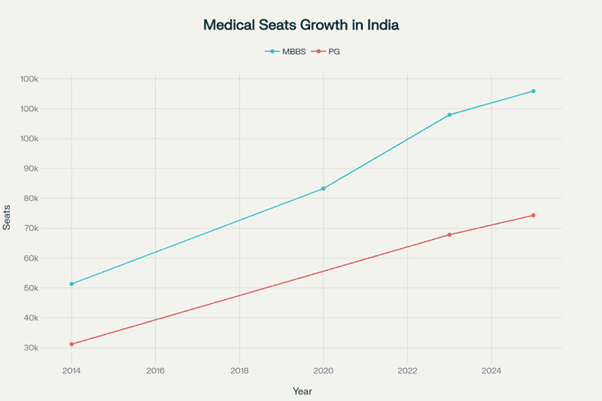
- MBBS seats rose from about 51,000 in 2014 to roughly 115,900 in 2025—around 130% growth.
- PG seats more than doubled over the same period, now above 74,000.
- More graduates should mean better access. In practice, many first jobs still look like paperwork, thin supervision, or a poor clinical fit.
After years of studying, I thought my first job would be clinical. Most days I chase insurance paperwork instead.
Early-career doctor, metro hospital
Patients are lined up. We still cannot find specialists willing to move—even with housing and stronger pay than many city offers.
Hiring lead, Tier-2 multi-specialty hospital
The mismatch is distribution, not a simple shortage
Most doctors still cluster in large cities. Roughly two-thirds of the workforce is urban, while rural India—home to most of the population—gets far thinner coverage. Metros fight over the same residency and consultant slots. Smaller towns stay understaffed, and patients travel farther for care that should be closer to home.
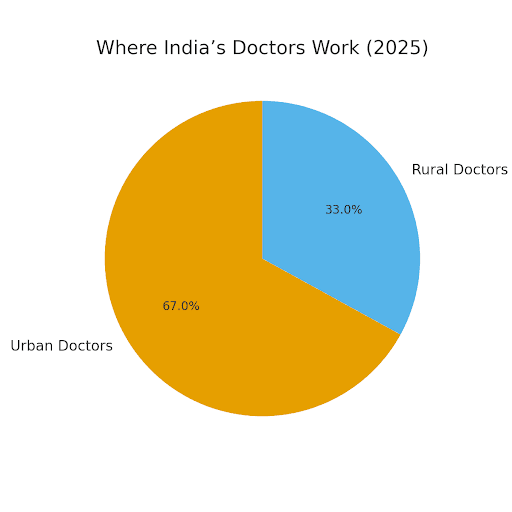
- About 66–74% of doctors serve urban India.
- Less than one-third serve rural areas where roughly 68% of people live.
- Rural density can sit near 3 doctors per 10,000 people, versus about 13 in cities.
What doctors actually weigh before saying yes
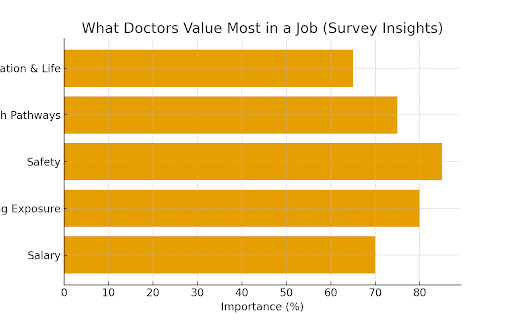
CTC alone does not close an offer. Doctors decide on the shape of the week: clinical exposure, safety, growth, and whether life outside the hospital is workable for a partner or family.
- Learning: real OPD and procedure exposure versus repetitive ward paperwork
- Safety: security presence, violence protocols, and how incidents are handled
- Growth: mentorship, academic pathways, or a dead-end duty roster
- Life logistics: housing, schooling, spouse employment, and call frequency
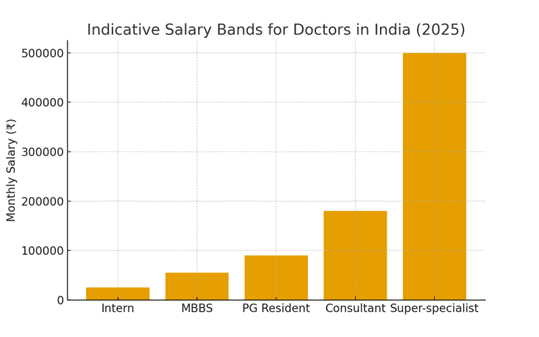
Salary bands doctors actually see
Pay varies widely by city, ownership model, and speciality. These ranges are directional guides doctors use when screening roles—not promises for every posting:
- Intern: ₹20,000–30,000 / month
- MBBS (0–2 years): ₹40,000–70,000 / month
- PG resident: ₹60,000–1.2 lakh / month
- Consultant (5–10 years): ₹1.2–2.5 lakh+ / month
- Super-specialist: ₹3–10 lakh+ / month, role-dependent
Why so many “open” roles still feel wrong
- Workplace violence remains a top concern for many clinicians.
- PG seats grew, but competition for the right training environment is still intense.
- Urban roles are oversubscribed; strong Tier-2 and Tier-3 openings stay hard to discover.
- Administrative load eats clinical time when the job description hides the real roster.
How Satayush approaches the match
- Hospitals share structured detail doctors ask for: OP/IP load, bed strength, duty roster, safety protocols, stipend, and incentives.
- Doctors filter by learning exposure, safety, housing, spouse placement, and call frequency—not only location and pay.
- Clinics and smaller hospitals get the same visibility as large metro brands.
- Paths beyond salary roles stay visible: revenue-share OPD days, partner-clinic models, and co-ownership where real.
Generic boards rarely capture NMC or bond context, rural incentives, or mentorship. Medicine needs that context before a doctor can say yes with confidence.
What better matching looks like
- An MBBS graduate in Pune finds a verified Tier-2 hospital role with clear safety protocols and real OPD exposure.
- A district hospital in Odisha fills a long-empty paediatric seat because housing and schooling were listed up front.
- A cardiologist steps out of city overload into a partner clinic in a growing district and builds a sustainable OPD.
That is not just filling vacancies. It is slowly correcting how India’s clinical talent is distributed—one honest listing at a time.
Ready to look past incomplete ads? Browse verified doctor jobs on Satayush, or post a structured opening if you hire for a hospital or clinic.
Browse doctor jobs